A while back, in the comments, Max and I got into a colloquy about how to drink while in "aero" on a tri-bike, without falling off. Max suggested the new Profile Design system that rests a traditional (or aero) water bottle on the aero bars, where they are easily accessible. I bought it. I hated it. My aerobars are set fairly close together, and with the water bottle and apparatus resting on top, the bottle interfered with a variety of my favorite hand positions. Also, when I hit a pothole, the bottle tried to jump out and nearly caused me to crash. I removed it after two rides.
Right before the NYC Tri, I decided to spend another chunk of change on the design that everybody else seemed to be using . . . This was also a Profile Design system, but instead of sitting up on the bars, the bottle rides between the bars. This seemed to work much better. The attachment to the bike was much firmer, and the bottle rested lower, so I did not feel like the straw was going to poke out an eye if I hit a bump. The only problem is that the lid seems to be designed so that you can refill on the fly by pouring liquid from the frame mounted bottle or a bottle exchange quickly without opening the container. I find this leads to a certain amount of splashing while the container is full. After a few sips, though the problem goes away. I've been using water, so it's no big deal anyway. I think Gatorade or other high tech nutritional drink might be more of a problem.
Saturday, August 24, 2013

PIPPEN v. NBCUNIVERSAL MEDIA LLC
The 7th Circuit affirms the dismissal of the defamation suit filed by NBA Hall of Famer, Olympic Dream Team member, top 50 NBA star of all time, and Michael Jordan wingman Scottie Pippin. Pippin alleged that various media outlets falsely reported that he had filed bankruptcy. This was untrue although he was undergoing financial difficulties. Easterbrook, Posner and Ann Williams uphold district court that this is not defamation under Illinois law. No visible running connection but two bloggers do bankruptcy and here in Chicago we still love Scottie.
My take on AA/US Air Merger Litigation
I will be appearing on the Bloomberg law podcast discussing everyone's favorite aviation merger case. It airs on Bloomberg Radio sometime on Saturday and then eventually eventually gets posted at http://www.bloomberg.com/podcasts/law/.
I am more sanguine about the government's case than Max, but not sure what exactly will be aired on the program since I did a twenty minute interview that gets chopped down to 6-7 minutes. We can discuss once I hear what they use.
My bottom line is that the complaint (if the facts prove as alleged) is consistent with the 2010 merger guidelines but somewhat more aggressive than past practice. I don't think its inconsistent to say that, in light of past mergers that weren't challenged or settled, that this merger raises unilateral and coordinated effects issues that cannot be fixed. There is no theoretical reason that discounted connecting fares cannot compete with non-stop flights for certain segments of air travelers, that is just a fact issue that I am sure the airlines will vigorously contest. I am pretty sure the merger is a terrible idea for air travel in and out of National Airport.
This actually reminds me of some of the steel mergers in the 1980s where whomever went first got cleared but later mergers got challenged as concentration rose. There was even an instance where one merger was announced and while that was pending a second merger in the industry was announced drawing a challenge to both, where neither probably would have challenged by itself.
Wednesday, August 21, 2013
Running Chicago's version of Queens
While Max was rocking his 70.3 Timberman, I was moseying my way around the Northwest side of Chicago on my weekend long run. It is a diverse multi-ethnic set of neighborhoods that blend into one another combining residential, commercial, and light industrial. The closest equivalent I can think of is Jackson Heights and other parts of middle class Queens but with more green space.
I have been in a holding pattern of 12-14 mile long runs while I wait to ramp up for the California International Marathon in early December. I ran the Rock n Roll Half in July and will run the Chicago Half in Hyde Park in early September and then my serious build.
On Sunday I ran south and west to Logan Square an increasingly hipster area encroaching on the mostly Hispanic surrounding blocks. There is a beautiful super-side boulevard with huge houses and even a mansion or two leading to a large circle where I headed off on the north and west spokes of Milwaukee and eventually Kedzie Avenue. Both have various restaurants and boutiques few of which were open as I cruised by at 8:30 AM. All told, probably 4 miles into my run.
Continuing north on Kedzie, I think I ran by at least 50% of the auto repair and body shops in the city. The farther north you go the more the Spanish language stores begin to mix with Korean and then Middle Eastern shops and businesses culminating in a small strip mall that had all three types of grocery stores in the same place! I am now at Mile 7.5 at the far north west corner of my run.
I headed home meandering back back toward the lake with a detour along the path bordering the Chicago River. When I came up to the street level I was greeted with the headquarters and museum for the Cambodian Association of Illinois which I would have toured except I was sweaty and gross and nothing was open on Sunday morning. More random streets brought signs in Polish, Serbian, Korean, and every ethnic restaurant you could imagine. At the corner of Irving Park and Clark I came to Graceland Cemetery where the high and mighty of Chicago's past and present are buried. As the day was heating up and I was tiring out I decided to hypotenuse home along Clark past the Friendly Confines on Wrigley Field and then head east the final blocks home. All told, something north of 13 miles the way I did it.
The river path intrigues me and I want to explore more heading away from my place. The problem is that the closest place I can pick it up is 3 1/2 miles from my home and it doesn't run uninterrupted until about 5 1/2 miles away which is usually close to turning around time. So I think either parking the car near the start of the path or some long one way runs are in order with some lucky Metra or subway riders getting to sit next to stinky me when I take the commuter train home from the burbs from done with the run.
Monday, August 19, 2013
Timberman
Couldn't talk Ted into running this one this year with his questionable foot, so P__ and I headed up from DC on Saturday -- an 8 1/2 hour drive with the traffic low -- and signed in to Ironman-branded Timberman 70.3, held on the roads and bike trails around Lake Winnipesaukee not far north of Concord, New Hampshire. I rode from the registration tent (at Gunstock Mountain Resort, a ski hill of regional and historic note that -- based on closed commercial properties nearby -- seems to have fallen on hard times) to the race staging area at Ellacoya State Park. That 10-mile ride gave something of a taste of the race course, comprised largely of pretty roads, steep climbs, and bombing descents.
I was late getting a room, so we stayed at an atrocious motor lodge just outside of Concord -- that's the last time I trust Tripadvisor reviews -- and had a simply phenomenal dinner at The Barley House in Concord. The capitol building is a beautiful gold-domed structure set among restored brick buildings that must date to the turn of the prior century. I've never been to Concord before and I found it to be a lovely town. Or at least a lovely downtown.
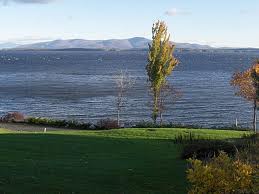 |
| Lake Winnipesaukee, taken from Ellacoya State Park |
 |
| Gunstock Mountain Resort, Gilford, NH (with tents much like on Saturday) |
My wave was at 7:30, so we left the motor lodge at 5:30 Sunday morning, grabbed bagels at Dunkin' Donuts, and drove 45 minutes back to Gunstock to catch a shuttle to the start. As much as I grouse about triathlon, I've done it enough that the stress of wondering what I left behind is mitigated. I keep in my frontal lobe the list of 14 things to bring with me to the transition/start in the morning: towel, goggles, cap, wetsuit, glasses, helmet, bike shoes, bike tools, bike computer, hat, running shoes, belt with number, hydration, and nutrition. All that goes in a bag and the morning setup takes 5 minutes.
The swim was either a Charley Foxtrot (military term -- use your imagination with the CF acronym!) or custom designed for a leg PR. Probably in an effort to keep an approximately constant flow of athletes on the course, using some underdeveloped optimization algorithm,* wave starts are hard to figure out. Sure, the pros go first. But then the waves run through most of the female competitors and several older age groups before turning to the two fastest age groups, men in their early 40s and late 30s. But it's not as simple as "pros first, slowest second," because the waves then move younger and for some reason insert the late-20s women -- an athletic group, but not competitive with the waves in the middle. The result is that after 5 minutes of nice swimming I spent the next 28 running over 30-year-old women from the prior wave. After having been run over by dozens before me, one swimmer lashed out and nearly bloodied my nose; it was all I could do to remember (1) be a gentleman, and (2) it's going a lot worse for her than it is for me! On the other hand, in constantly catching and passing earlier starters, I almost never had to break my own water. (It probably does not need to be said that the drafting effect is just as strong in swimming as it is in biking, only in the swim it is legal.) At 33:04, my fastest 1/2-iron swim split but one, and that one race -- the now defunct Black Bear 1/2 in Pennsylvania that I ran in 2008 -- had a notoriously short swim course.
*Brainstorm: a PhD thesis for an Operations Research grad student might analyze the optimal starting pattern for a timed event.
The bike course at Timberman is in equal parts challenging and inspired. We rode beautiful roads over the shoulder of Gilford Mountain before taking a long gently sloped downhill grade to the turn-around. The pavement was almost all very good. That long gently sloped grade was uphill for 15 miles returning, before we once again climbed the shoulder of the mountain and bombed back down to the end at 56 miles. My measure of its difficulty is in looking at the top pro times.* Andy Potts, maybe the greatest currently competing American male triathlete, took just under 2:11 to ride this course. In contrast, my last 1/2 IM was in Boulder almost exactly a year ago. That course took Joe Gambles a mere 2:00 to ride the year I was there. We've been spilling more ink on bike splits this year at runningprofs than we have in the past, so to add to that I was undeniably thrilled to ride my best ever 1/2 iron bike time on my hardest ever 1/2 iron bike course.
* One could debate this approach: what does a pro's experience tell me about my own? My view is this: a pro triathlete is somebody who has figure out how to remove subjective factors from the event -- i.e., to perform at a consistent level given the external circumstances. Thus, winds, hills, heat, what-have-you, will have a consistent impact on a pro's performance. One might accomplish a similar thing with average times, but that average would include amateurs like me who suffer subjective limitations based on distaste for a particular challenge.
 |
| In case the grimace doesn't tell it, let me: I was hurting! |
Then came the run. Of all the legs this is the one I was least concerned about. Based largely on my experience this year at the Columbia Triathlon, I've come to believe that you can't plan for the run in a triathlon. You are either ready for it or you are not, but if you set aside some reserves for it you will flop in the rest of your race. And unlike the bike, the run you can do from your large and deep muscles in the gluteals and the stomach, which survive much longer than your legs. I left T2 with my watch reading 3:06 and lots of change, several minutes ahead of my prior best time at that point, shooting for a run leg PR. The first mile was too fast (it always is!) and I then settled in at a 7:00 pace until mile 8 or so or so before really, really hurting on the fourth time up the hill in the middle of the out-and-back course. No walking, but I may as well have for a while there. I wanted a 1:32 but finished in 1:35 and a very few seconds for that half-marathon -- for the third time in the day, my best ever for that leg of the race. If you'll forgive the self indulgence, here's a finish chute photo from the run. (Look, coach, good posture!)
More than I intended to write, but there it is. A big PR at 4:41:52; 11th in my age group; and 90th overall -- my first time ever cracking the magic 100 mark in an IM-branded event.
Saturday, August 17, 2013
New Frontiers in Hydration
So today I had the best workout I've had in months. I met some Brooklyn Tri-Club folks in Fort Lee for a ride up route 9W. We did 60 miles at medium intensity, with 5 miles of hammering at 25 miles an hour at the end. Then we went for an easy 3 mile run. The big victory was that I managed to run at a reasonable clip (considering), and my heel seems okay. Hooray!!
We stopped at one of the usual muffin shops, but the gang wanted to get going before I'd finished my (very hot) double espresso. Rather than toss it, I poured it into my water bottle making an ad hoc Americano. I think the next time I'll do this on purpose. It turned out to be a nice change from water or sports drinks. I might add a little sugar. Who knows??
Thursday, August 15, 2013
US v US/AA
Rhetorical query: first time the US has sued itself?
More interesting query: first time the antitrust division has seen connecting routes as competitive with non-stop service for purposes of finding an overlap in a merger matter?
My 2c: the overlaps are not what is driving this complaint. In fact, with regard to market definition, the complaint is schizophrenic: on the one hand, US Airways' connecting flights are seen as competitive with other carriers' non-stop flights (logical in its own right, as there is a discount level at which I will start flying one-stop on my regular DC-Indy route); but on the other hand, Southwest and JetBlue are said to serve a different customer base than the "legacy carrier" (also logical in its own right). Taken together, the arguments are difficult to reconcile.
Rather, what is driving this complaint is the second claim: that National Airport will become even more of a fortress hub than it is. With 70% of slots at a slot-constrained airport, the new American will have a stranglehold on travel to the nation's capitol. Note that Virginia's attorney general Ken Cuccinelli, more nutso right-winger than bleeding heart, added his name to this complaint.
I can also envision that slots at National would be a huge sticking point in the negotiations leading up to this complaint. No doubt US Airways is salivating over American's slots and the Justice Department want an agreement to divest those slots to JetBlue.
I will say I am looking forward to using this tidbit in the spring semester antitrust class: an invitation to collude that was not accepted. (See p. 17, para. 45.) Echoes of "you raise your goddamn fares twenty percent and I'll raise mine the next morning!"
As is too frequently the case, my own contributions to the popular press conversation on this topic lack the depth I'd like them to have. Glad at least to see that I appear to see this similarly to Diana Moss, who wrote the excellent AAI White Paper a year ago.
Subscribe to:
Posts (Atom)