I'm glad to read (and see -- great pictures) running has been nice in Chicago and Brooklyn! We had 96 degrees in Louisville, and that doesn't capture the heat radiating from the road -- so substantial I couldn't ride long in the so-called aero position (which places the head closer to the ground). I dried up completely, napped for 20 minutes 5 miles before the end of the bike leg of the triathlon and called it a day without running a step. I'm pretty bummed, but at least I'm in good company. Some 30-40% of the professional triathletes in the race failed to finish, many giving up before the end of the bike. On the other hand, thousands of people finished the race, including some who were just finishing the bike and embarking on their marathon 11+ hours after the race start. Now, that's an Ironman.
Trying to resurrect something out of my failure, I wondered if this helps my analysis whether to give mid-term exams, or use some other form of a two-part exam structure. It is heart-breaking to spend months devoted to success at something and have the day just fall apart. I've always rationalized that "that's the way it is in the real world," as if the real world is all preparing for a single court argument or client meeting. But of course that's not so. Nowhere but in endurance racing (which is unique because you can't just get back on the horse the next week) and law school exams are people judged by what they do on one day.
Now, I have to decide whether long-course triathlons are in my future. As I said to somebody before the start, I really do enjoy running 10Ks.
Monday, August 30, 2010

Sunday, August 29, 2010
Running: New Routes on Both Sides of the East River
Okay, so today was a milestone run in lots of ways. First of all, it was one of those prayed for cool clear fall days. It is also likely the last one for a bit, as the weather is about to turn hot again. Second, it was a day where I really had to start ramping up my long runs, or give up on the idea of the Philadelphia Marathon. My longest run since June has been 11 miles, and I like to do 3-4 20s before my Fall Marathon. That means I need to run my first 20 in 3 weeks. Yikes!! 15 today was an absolute necessity. Mission accomplished.
More important, though, it was a day where a couple of new, and wonderful running routes opened up. Michael Cahill and I basically ran our usual loop of the Brooklyn and Williamsburg bridges, but as we arrived at the East River, we saw that a new section of waterfront bike path had opened up.


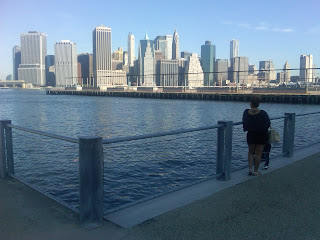

More important, though, it was a day where a couple of new, and wonderful running routes opened up. Michael Cahill and I basically ran our usual loop of the Brooklyn and Williamsburg bridges, but as we arrived at the East River, we saw that a new section of waterfront bike path had opened up.

Above is a picture of the path looking back toward the Williamsburg Bridge. Below is a picture of the path looking North..

We couldn't resist adding a couple of miles extra, just to check out the views. That's Cahill in the red t-shirt, politely waiting for me to finish taking pictures (not!).
Then once we were back in Brooklyn, I decided to add the necessary miles by running through Cobble Hill, and then down Atlantic Avenue to the new Pier One. This new part of Brooklyn Bridge Park opened a few months ago, and is quite spectacular.

Up until now, it hasn't worked as part of a run, because it didn't connect up with anything, but the folks building the Park just opened up a makeshift bike path that connects with the other newly constructed part of the Park at Pier 6.

I'd have taken a few pictures of Pier 6, but when I got there, I bumped into a friend who was about to get into a kayak to paddle about in the new Kayak cove. I got distracted.
Anyway, as I mentioned in an earlier post, New York is slowly but surely beginning to make better use of its waterfront. Lucky me.
Saturday, August 28, 2010
Bike Ride
So today was gorgeous, and I went for a longish 50 mile bike ride with a BLS alum. We've been promising to ride together for about six years, and finally found the right morning. Boy was it the right morning. Clear blue sky, cool temperature, no wind. Of course, I overslept, couldn't find my gear, and dashed out of the house in a hurry, but thanks to IM, nobody ended up waiting long.
We rode up the West Side, over the George Washington Bridge, up 9W to Piermont. This is a pretty standard ride for New York City dwellers, and there are always lots of cyclists. Frequently, you can hop onto a pace line, and pretty much everybody stops at Bunbury's for a muffin and coffee before turning around. This is one of the things I've always liked about cycling. Runners often talk among themselves, but rarely end up talking to unfamiliar runners. Cyclists form temporary packs, share pacemaking, sometimes try to drop each other, and frequently end up chatting -- usually about gear.
It's interesting that two basically aerobic sports can have workout cultures with very different "vibes."
We rode up the West Side, over the George Washington Bridge, up 9W to Piermont. This is a pretty standard ride for New York City dwellers, and there are always lots of cyclists. Frequently, you can hop onto a pace line, and pretty much everybody stops at Bunbury's for a muffin and coffee before turning around. This is one of the things I've always liked about cycling. Runners often talk among themselves, but rarely end up talking to unfamiliar runners. Cyclists form temporary packs, share pacemaking, sometimes try to drop each other, and frequently end up chatting -- usually about gear.
It's interesting that two basically aerobic sports can have workout cultures with very different "vibes."
Friday, August 27, 2010
Just Plain Running
I plan to write something semi-profound about why I run over the weekend. Suffice it to say, my reasons and motivations are different from both of my fellow bloggers. Nor can I wax eloquent about triathlons since I have never done one. (Was signed up for a sprint one once but it was thunder storming that morning so I went back to bed).
All I can offer for the moment is a lovely 10 miler as I prepare for the Chicago half-marathon in a couple of weeks. I was a little bored running up and down the lakefront so I zigzagged my way south west through the back streets of various neighborhoods on my way to my turn around point in the middle of Humboldt Park. This is the old immigrant neighborhood which Saul Bellow made famous in The Adventures of Augie March ("I am an American, Chicago Born..."). It also happens to be where my dad grew up. The park itself is gorgeous and the neighborhood was begun to gentrify particular on the east and north sides. Sadly that gentrification has swallowed my dad's former home, which is now a Walgreen's.
It was glorious weather, a good pace even with occasional breaks for traffic, and plenty of neighborhood sights. Given that Chicago is a basically a grid with few diagonal streets (and none running the proper way on my way home) I didn't have to worry about distance and once I hit my turn-around, I could take any combination of streets home. The feet held up nicely even on all pavement, which was an important test for the Chicago half which is an awesome race but all streets.
All I can offer for the moment is a lovely 10 miler as I prepare for the Chicago half-marathon in a couple of weeks. I was a little bored running up and down the lakefront so I zigzagged my way south west through the back streets of various neighborhoods on my way to my turn around point in the middle of Humboldt Park. This is the old immigrant neighborhood which Saul Bellow made famous in The Adventures of Augie March ("I am an American, Chicago Born..."). It also happens to be where my dad grew up. The park itself is gorgeous and the neighborhood was begun to gentrify particular on the east and north sides. Sadly that gentrification has swallowed my dad's former home, which is now a Walgreen's.
It was glorious weather, a good pace even with occasional breaks for traffic, and plenty of neighborhood sights. Given that Chicago is a basically a grid with few diagonal streets (and none running the proper way on my way home) I didn't have to worry about distance and once I hit my turn-around, I could take any combination of streets home. The feet held up nicely even on all pavement, which was an important test for the Chicago half which is an awesome race but all streets.
Armchair empiricism and triathlon
Further obsessing about this weekend's race, I conducted my own empirical analysis of my success in triathlon. My n is about 10. I conclude that a good run equals a good triathlon and the rest is all set-up. I've had some good rides (for me) in a few races -- in the DC Triathlon this June I had my strongest ever 40 km ride, and in the Great Illini in September 2008 I rode my personal best for the bike leg of an iron-distance race. But in neither was my overall result satisfying. I had a great swim in Cozumel last December (I think the course was short, and we had a strong current for most of the swim -- on top of which, I was watching clown fish playing beneath me!), a moderate but not great bike, and tanked the run for a disappointing result. But there is a 100% correlation between my having a strong run leg and a pleasing result, at the Olympic distance (Luray, Virginia triathlon two weeks ago) and the 1/2 iron distance (two races in Oregon in the past few years). I've never had a good run in an iron distance event, so I have no idea if the result adheres. But the race plan for this weekend is to enjoy the swim, if that's possible in the Ohio River; relax on the scenic but rather hilly bike course; and make a mental commitment to a strong run. Here's hoping.
Wednesday, August 25, 2010
It's Not About the Race
Max raises an interesting question -- why do we race. This is a good year for me to ask that question. Last year I added triathlons to my routine. Instead of running a marathon each Fall, and a few races the rest of the year, I trained for my first Olympic distance tri in 2009, and completed a half ironman in 2010. Along the way I did a number of sprints for practice. I also ran the Dublin Marathon with Spencer and Max. That's a lot of racing. So, I must like racing, right? Short answer is that I'm somewhat ambivalent about races. There are things I like about races: The energy at the start, the sense of accomplishment at the finish, the elation after a day has gone well. But there are other things I don't like: the crowd scene at the start, the frustration about opportunities missed, or training errors that manifest in mile 18 . . .
The part I like, pretty much unequivocally, is the training. I like the freedom of long runs, the conversations with friends, the variety of swimming, biking and running. The reason for races is that they organize and motivate my training. Without a race to train for, my workouts lack focus. Without races, I can't measure my progress. Without a race to train for I would not have the lurking fear of the "wall" to get me up each morning for a long workout. The race is the end that motivates the means. Or is it the other way around? Training is the end, and the race is the means??
The part I like, pretty much unequivocally, is the training. I like the freedom of long runs, the conversations with friends, the variety of swimming, biking and running. The reason for races is that they organize and motivate my training. Without a race to train for, my workouts lack focus. Without races, I can't measure my progress. Without a race to train for I would not have the lurking fear of the "wall" to get me up each morning for a long workout. The race is the end that motivates the means. Or is it the other way around? Training is the end, and the race is the means??
Why I Race
With one of my target races for the year coming up this Sunday (coinciding with the beginning of the semester, which sounded like a good idea at the time), I thought I'd post an edited version of this slightly long musing I came up with last year. Because it really is a musing, I've not taken the obvious next step of annotating with references to the economic literature on search costs or cognitive psychology literature on decision-making.
This has been a big racing year for me. My wife Patricia once asked (perhaps hiding her exasperation) what I get from running races. I lined up to start the Austin marathon in 2009 and thought it over. What was I hoping for when the starting gun sounded?
I get from a race singleness of mind and purpose. For the time I am running, I have no purpose in life, no goal, no raison d’etre, but to finish the race. When the gun sounds, I have ahead of me more than three hours of none of the complications or worries of life.
It only works in a marathon, or, I suppose, something longer. I think the task has to be daunting enough that no brain space is left for anything else. Running shorter isn’t easier, but it requires less mental effort, or at least mental effort exerted for a lesser period of time. There is room for worries to slip in. There’s the rub, too. If I do it too much, will the marathon cease to be a substantial enough event?
I found myself discussing the military with another. He said he could see the attraction of joining up. That was a startling revelation. S_____ is quite free-willed. I think I would struggle under the constrictions of military life. He would be a disaster. I told him so. He was serious, though. The military offered something attractive. What was it? Maybe the same thing: singleness of mind and purpose. In the military, like the three-plus hours after the starting gun in a race, there is nothing to do but the task at hand. Never do you have to decide, for yourself, where you will go, how you will eat, where you will sleep, or who you will follow. Complications of life are shut out. (I haven’t talked about going to prison, but I suppose that fits, too.)
If the military serves this purpose, why should the luxury be limited to those in uniform? Does it not apply to the populace at large? What if we did not need to run marathons to remove complications from our lives? What if the government did that for us? Of course, I am describing a totalitarian regime. I am discussing the Soviet Eastern Bloc or the fundamentalist Muslim world. There is empirical support for the idea of totalitarianism as utopia. When capitalism entered Eastern markets in the 1990s, consumers were overwhelmed by choice. Some believed it was not a good thing. Why should they decide what cereal to buy – wasn’t that an unnecessary complication? If choice were removed for us, a necessary corollary is that bad choices would go away. (Knowing I am starting to sound like a certain law professor-cum-regulator, I’ll wrap things up.) Lack of choice doesn’t mean circumstances are optimal, it just means the energy spent worrying about it is placed elsewhere.
I have now come a long way from running marathons, I realize. I don’t think extinguishing choice is a solution. But I voluntarily do that to myself with regularity. I enter the place where the only way to go is forward, and the only thing to do is to run. These were my thoughts, that day in Austin. My thoughts on the run.
This has been a big racing year for me. My wife Patricia once asked (perhaps hiding her exasperation) what I get from running races. I lined up to start the Austin marathon in 2009 and thought it over. What was I hoping for when the starting gun sounded?
I get from a race singleness of mind and purpose. For the time I am running, I have no purpose in life, no goal, no raison d’etre, but to finish the race. When the gun sounds, I have ahead of me more than three hours of none of the complications or worries of life.
It only works in a marathon, or, I suppose, something longer. I think the task has to be daunting enough that no brain space is left for anything else. Running shorter isn’t easier, but it requires less mental effort, or at least mental effort exerted for a lesser period of time. There is room for worries to slip in. There’s the rub, too. If I do it too much, will the marathon cease to be a substantial enough event?
I found myself discussing the military with another. He said he could see the attraction of joining up. That was a startling revelation. S_____ is quite free-willed. I think I would struggle under the constrictions of military life. He would be a disaster. I told him so. He was serious, though. The military offered something attractive. What was it? Maybe the same thing: singleness of mind and purpose. In the military, like the three-plus hours after the starting gun in a race, there is nothing to do but the task at hand. Never do you have to decide, for yourself, where you will go, how you will eat, where you will sleep, or who you will follow. Complications of life are shut out. (I haven’t talked about going to prison, but I suppose that fits, too.)
If the military serves this purpose, why should the luxury be limited to those in uniform? Does it not apply to the populace at large? What if we did not need to run marathons to remove complications from our lives? What if the government did that for us? Of course, I am describing a totalitarian regime. I am discussing the Soviet Eastern Bloc or the fundamentalist Muslim world. There is empirical support for the idea of totalitarianism as utopia. When capitalism entered Eastern markets in the 1990s, consumers were overwhelmed by choice. Some believed it was not a good thing. Why should they decide what cereal to buy – wasn’t that an unnecessary complication? If choice were removed for us, a necessary corollary is that bad choices would go away. (Knowing I am starting to sound like a certain law professor-cum-regulator, I’ll wrap things up.) Lack of choice doesn’t mean circumstances are optimal, it just means the energy spent worrying about it is placed elsewhere.
I have now come a long way from running marathons, I realize. I don’t think extinguishing choice is a solution. But I voluntarily do that to myself with regularity. I enter the place where the only way to go is forward, and the only thing to do is to run. These were my thoughts, that day in Austin. My thoughts on the run.
Subscribe to:
Posts (Atom)